How MDF Board Has Superseded Traditional Wood in Market Demand
Posted on December 18, 2025
Medium-Density Fibreboard (MDF), an engineered wood panel, is made by the hardwood or softwood into fibres and blending them with wax and resin. The whole process results in the transformation of dense panels under high temperature and pressure. Contrary to traditional solid wood, directly sourced from oak, pine or mahogany, MDF has natural uniformity, free of knots or warping.
Innovated in the 1960s, MDF has topped its popularity since the 1980s due to several market metrics, rapid urbanization and resource scarcity.
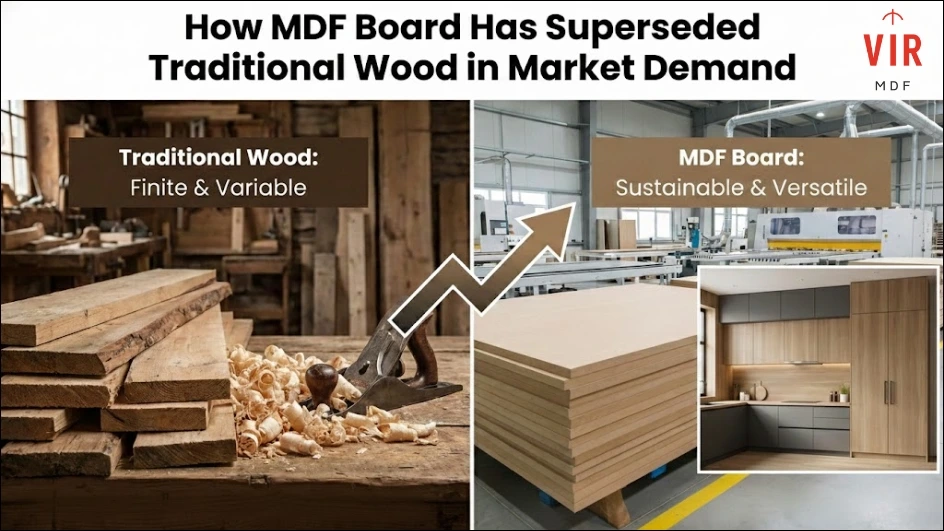
Evidential Supersession of MDF
MDF’s supersession is driven by the different market metrics, steering its market demand around the globe. As per the Food and Agriculture Organization (FAO) data 2023, its global production reached 112 million m³. While in 2024, the global output of nearly 119 million m³ outstripped the solid sawnwood CAGR of 1.8% as compared to MDF's 7.5% (Statista 2025). Bangladesh Panel Association 2025 data highlight a 28% YoY surge in MDF’s production, which is equivalent to 1.2 million m³ output, helping to capture almost 55% furniture board demand market. Further, according to the Housing Industry Association (2024), the 62% MDF use in the modular interiors market of Australia is equivalent to an AUD 1.2 billion value.
MDF’s demand dominance stems not only from its innovative raw material but also from addressing natural wood’s core limitations in alignment with changing urban demography and national sustainability goals.
Key Drivers behind MDF’s Popularity Surged
MDF’s multiplied market growth is driven by the following macroeconomic and technological factors –
- According to the WWF Living Planet Report 2024, global forest loss reached 430 million hectares, inflating teak prices by 22% in South Asia. The concerns around deforestation have catalyzed the shift to MDF-like material. By recycling 85-95% wood waste (sawdust/chips), MDF can conserve 2.3 trees per m³ (European Panel Federation). Also, in Asia and many countries around the globe, MDF factories leverage agro-waste to align with the goal of carbon neutrality and a green planet.
- Scalability in production matters more. Compared to slow-growth cycles (20-50 years per tree) and 25% waste of traditional wood harvesting, MDF factories operate 24/7 with 90% yield efficiency. The global dominance of China, 52% share (International Wood Panel Association), and exporting cheaply to Bangladesh and Australia is cutting down the wood usage by 35-45%.
- Rapid urbanization fuels the demand. Popularity of short-term construction schedules, specifically in India, Bangladesh and Southeast Asia, prioritizes the demand for quick-assembly materials. MDF’s flat and uniform surface perfectly suits the criteria of the modular furniture industry and outpaces the wood’s variability.
Understand the significance of the following economic data: Grand View Research indicates that the global MDF market hit $45 billion in 2023, projecting $65 billion to reach by 2030, compared to the solid wood furniture market stagnating at 3% growth.
Read More: Future Trends in the Evolution of Best MDF Boards
Technical Superiorities: MDF’s Winning Factor
The machinability and finishing quality of MDF are working as core fundamental factors behind its demand surge. The homogeneous density (600-800 kg/m³) of the same material allows precision cutting, routing and shaping without splintering, ideal for CNC machining. As per USDA Forest Service data, wastage in traditional wood is around 10-15% during processing due to grain inconsistencies.
Surface smoothness helps to excel in finishing. Accepting paints, veneers and laminates seamlessly. MDF replicates high-end wood at 30-50% less cost. As per Alibaba wholesale averages, a 1.2m x 2.4m MDF sheet costs $15-25 versus $50+ for equivalent oak. Fire-retardant and moisture-resistant variants (MR MDF) further boost appeal, due to standard MDF swells <8% in humidity. This criterion outperforms solid pine's 15-20%, based on ASTM D1037 tests.
Dimensional stability plays a pivotal role. Compared to a 5-10% expansion/contraction of wood seasonally due to humid conditions, MDF’s resin binder minimizes this drawback to <2%. Hence, MDF furniture has an extended longevity in humid climates like South Asia. These traits drive adoption, supported by data that 70% of the Indian furniture industry uses MDF (Furniture Design India report, 2024).
Economic and Supply Chain Advantages
Production economics drives supersession of MDF: FAO 2025 data show $220/m³ production cost in comparison to $450-650 of seasoned hardwood. Vertical integration of supply chains – factories near sawmills recycling waste to pressing, cutting logistics cost by 30%. In the case of the traditional wood supply chain, from logging to seasoning, inflated prices amid labor shortages and export tariffs.
Effortless scaling of the customization factor presents the following evidence: MDF criteria like standard sizes (1220x2440mm), thicknesses (3-25mm), and grades (E0/E1 emission standards), fulfill regulations like CARB Phase 2 for low formaldehyde. This versatility suits mass production demand: reporting of IKEA shows 80% of its flat-pack lines use MDF cores.
Environmental sustainability amplifies its value. MDF sequesters carbon similarly to wood but reduces harvest pressure; 1 ton of MDF saves 2.5 trees (European Panel Federation).
The green planet goal prioritizes certifications like FSC as it prefers recycled content. Especially in eco-conscious Europe and Australia, this advantage boosts B2B demand.
Read More: Know your MDF Sheet Sizes, Surface and Thickness
Dominant Applications of MDF
The furniture industry’s preference to use MDF for its diversified products like wardrobes, cabinets and table tops is triggered by the material’s criteria of paintability and strength-to-weight ratio (MOR: 30-40 MPa vs. pine's 40-50, but with better screw-holding). In South-Asian countries like India, MDF furniture exports grew 25% YoY (Export Promotion Bureau, 2024), replacing teak.
As modern interior designers are driven by the advantages of Laminate-faced MDF and HDFWR (High Moisture Resistant) MDF, they use it in flooring, doors, moldings, kitchens and bathrooms to get better aesthetics and water-resistant capability than other plywood alternatives.
In construction applications, MDF doors outsell wood 3:1 in urban housing (MarketsandMarkets 2025). Acoustic MDF panels and decorative ceilings leverage their moldability. Even automotive interiors (dashboards) and packaging shift to MDF for lightweight durability.
Final Thoughts
Despite huge benefits, MDF also experiences challenges like compressive strength (35 MPa) lagging behind oak's 50 MPa for heavy loads, restricting structural beams, and standard grades absorbing water rapidly (edge swell 15%). However, HDFWR variants help to mitigate these flaws up to 2%. Also, early formaldehyde concerns (10 ppm) were resolved via phenolic resins (<0.3 ppm E0).
MDF’s versatility supersedes the wood’s tactile appeal and refinishing features. Outstripping wood’s endurance in luxury niches, MDF’s global market data and regional shift reflect its supersession. Finally, MDF will claim 78% panel market by 2035, superseding wood via adaptability and eco-alignment.