The Rise of CNC-Cut MDF Designs in Furniture Production
Posted on November 28, 2025
The introduction of technology in the furniture segment has brought a significant transformation. Blending of CNC (Computer Numerical Control) technology with cutting and designing Medium Density Fibreboard (MDF) offers optimal outcomes. Due to a combination of precision, efficiency and creativity, the CNC-cut MDF designs are superior to traditional manual methods and selected for extensive application. Its versatility and sustainability offer a revolutionary impact and the emergence of CNC-cut MDF is expected to reshape the future outlook of the furniture sector.
Use the efficiency and quality of MDF designs to avail of the benefits of flexibility, consistency, and customization.
MDF – Preferred Reasons for Furniture Production
As an engineered wood product, MDF is made from wood fibres bonded under heat and pressure with resins and wax. Due to its smooth surface and uniform texture, MDF is recognized as an ideal substrate for CNC machining. The criteria of cost-effectiveness compared to solid wood and plywood, high dimensional stability, and minimal waste production during cutting make this material most compatible with wide applications in the furniture industry.
Avail the benefits of sustainability as CNC-cut MDF contributes to resource conservation and eco-friendly furniture production.
Understand the Role of CNC Technology in MDF Processing
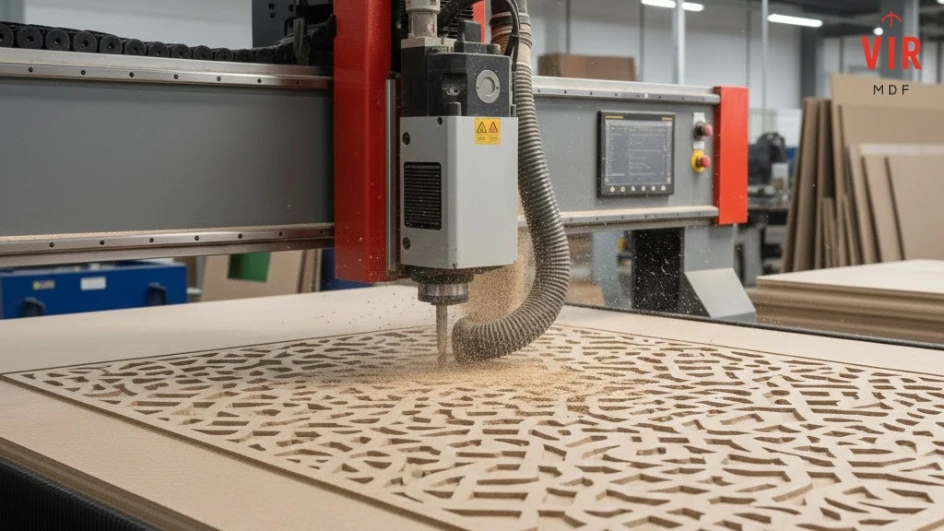
By using computer-controlled automation, CNC machinery is capable of doing cutting, drilling and carving tasks with high accuracy and precision. Also, the CNC routers can cut the MDF boards to transform 2D and 3D digital designs into perfect physical furniture components.
Look at the key features that CNC technology in MDF processing offers –
- Micron-level precision in cuts and engravings, minimizing manual labour tasks like sanding and finishing.
- Capable of producing complex shapes and intricate patterns, which are quite impossible with manual tools.
- In large-scale production, where managing product uniformity is a must, CNC-cut MDF ensures consistent replication of parts.
- Efficient material usage with nesting software to reduce waste to below 5%.
- Enhancing production speed with less human error and faster turnaround times.
Read More: The Most Efficient Tools for Cutting MDF
Benefits of CNC-cut MDF in Furniture Production
CNC technology offers aesthetic finishes and creative freedom without compromising the quality aspect.
Know the diversified advantages that CNC-cut MDF designs offer to you –
- With exceptional precision and quality control, CNC technology not only minimizes human error but also consistently ensures every part fulfils design specifications. Offering durability and superb finish quality, this technology reduces waste and rework costs to boost manufacturers’ profitability.
- CNC’s programmability allows for innovation and customization for designers. Explore avant-garde furniture concepts, as the layered textures scale up your creative aspect.
- Increase your production speed as CNC supports bulk production and customization without sacrificing quality. Compared to traditional methods, this technology allows manufacturers to meet diverse customer demands effectively.
- MDF, often using recycled wood fibres, CNC machinery minimizes material wastage to promote a sustainable manufacturing process.
Read More: Cut the MDF Board like A Pro with Some Effective Tips
Addressing Challenges in CNC-MDF Furniture Production
Despite quick prototyping and iteration, CNC-MDF technology is not free of drawbacks. Understand the following challenges to overcome the vulnerabilities and enhance operational safety –
- MDF is susceptible to moisture, causing swelling and durability issues. Use proper sealing and finishing techniques to protect CNC-cut furniture.
- The use of high-quality CNC routers and software requires significant upfront capital. Due to the initial high investment cost, CNC-cut MDF designs may create barriers to small-scale manufacturers.
- As CNC cutting generates fine wood dust, managing operational safety and dust control is necessary to protect workers’ health and maintain workspace cleanliness.
- CNC technology requires a skilled workforce for deployment in the furniture segment. Programming and maintenance criteria require ongoing training and investment to develop specialised skills among workers.
Also, quality control supervision is necessary to adhere to design-specific tolerances in the large-scale furniture production segment. Understand and learn the techniques to maintain modern efficiency and redefine industry benchmarks.
Future Trends and Innovations in CNC-cut MDF Furniture
The intersection of CNC and MDF is a great effort to accelerate the future growth of this industry. Achieve the benefits of further innovation through the following ways -
- Facilitating seamless digital workflows by integrating design and manufacturing software platforms (CAD/CAM), resulting in enhanced efficiency and minimized errors.
- Application of advanced cutting technologies like laser and plasma cutters offers complementary precision and detail options, supplementing traditional router capabilities.
- Use of robotic systems helps in material handling, assembly, and finishing tasks. By endorsing the end-to-end automated furniture production lines, this expansion process redefines the industry benchmarks.
- Increasing use of eco-friendly MDF variants promotes the green planet objective by lowering environmental footprints while retaining machinability.
Blending sustainability and technology, the future trends in the furniture segment will evolve around environmentally responsible, customizable, and durable furniture products. With growing consumer awareness of resource conservation and a greener planet, future trends in the furniture segment will consistently innovate toward a smarter and more efficient production system.
Understanding the Market Perspective
Several factors, like rapid urbanization and expanding market economy, trigger the demand for CNC-cut MDF furniture designs, resulting in the production of more intricate, tailored and aesthetic pieces. The inherent versatility and affordability of MDF make it a preferred choice for designers to cater to the dynamics of the expanding market. Also, nowadays, e-commerce platforms facilitate a wider market reach and provide customized furniture options to consumers. Hence, the manufacturers increasingly adopt design diversity, supported by CNC machinery capabilities. The rising consumer awareness regarding eco-friendly products compels manufacturers to adopt sustainable MDF variants and CNC-supported production processes. The combination of these factors enables the producers to optimize material usage, improve product consistency, and reduce lead times. As such, CNC-cut MDF is considered a strategic growth vision to capitalize on shifting consumer preferences and technological advancements, which will reshape the future furniture industry.
Conclusion
From the above, it can be stated that CNC-cut MDF furniture production presents the perfect integration of advanced digital technology, automation, and sustainable material innovation. The use of CAD/CAM and robotic automation systems not only offers efficiency but also precision and versatile design capabilities. As personalization and digital sales platforms indicate the market trends, manufacturers can achieve profitability with a blend of advanced technologies and sustainable MDF variants. Finally, achieve unparalleled performance, quality, and sustainability only with CNC-cut MDF designs, which will redefine the industry’s future standards.
Uphold environmental and operational excellence only with CNC-cut MDF furniture manufacturing, making a sophisticated and aesthetic difference in the coming years.